
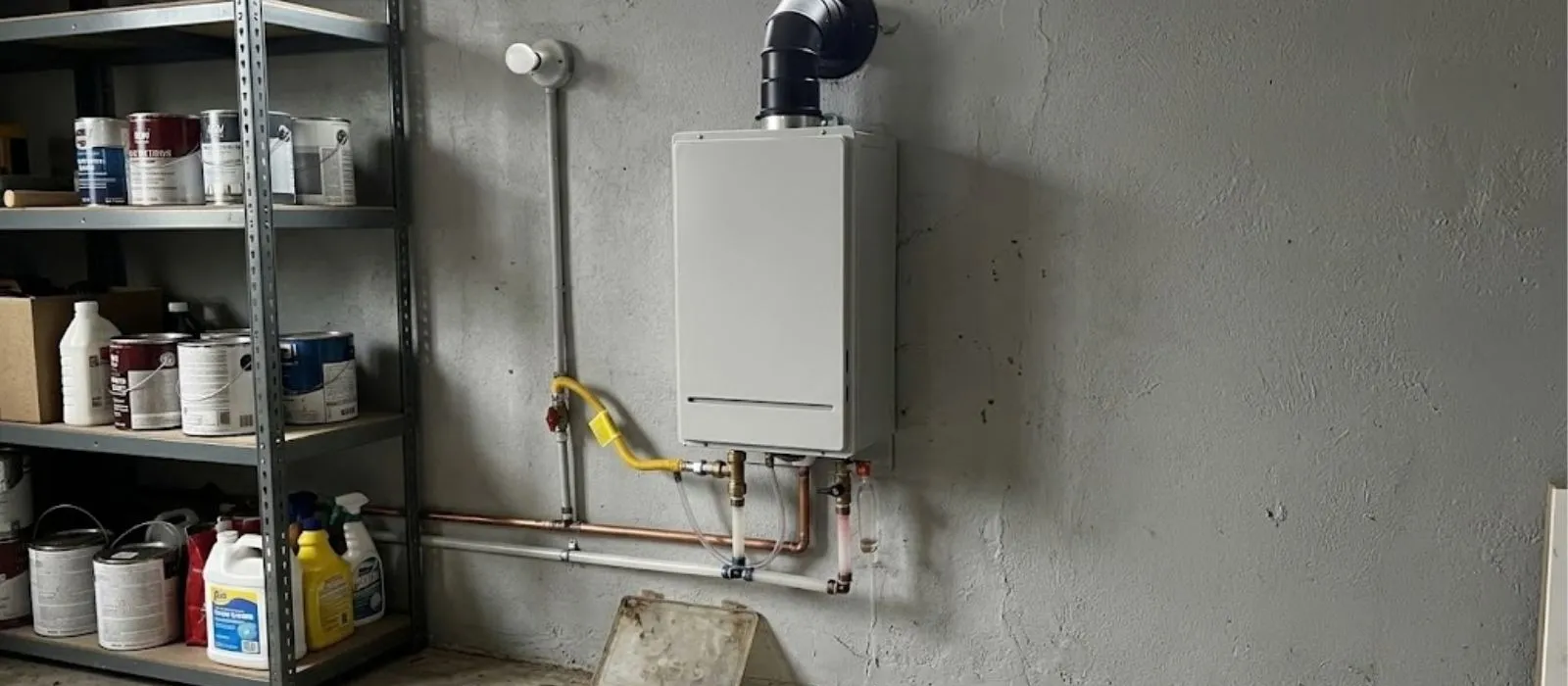
Why tankless heaters do not have anode rods
An anode rod is a metal rod inside a storage tank water heater. It is made of a metal that corrodes more easily than steel, so it corrodes first and protects the tank. Once the rod is used up, the tank begins to rust.
A tankless heater has no tank. Water passes through a heat exchanger and leaves hot, so there is no large steel vessel to protect. That is why you will not find an anode rod in a tankless unit.
That does not mean a tankless heater needs no care. It has a different weak point, and it is mineral scale.
What protects each type of heater
The threats are different, so the care is different.
| Type | Main threat | Protection |
|---|---|---|
| Storage tank | Corrosion of the steel tank | An anode rod that is checked and replaced |
| Tankless | Scale on the heat exchanger | Regular flushing and, where needed, water treatment |
What scale does to a tankless unit
It builds slowly, then causes obvious trouble.
Lower flow
Scale narrows the passages in the heat exchanger.
Error codes
The unit senses overheating or poor flow and shuts down.
Higher gas or power use
Scale insulates the exchanger, so more energy is needed.
Noise
Scale can cause rumbling or popping.
Shorter life
Heavy scale damages the exchanger.
Tankless unit throwing error codes?
Call and a plumber can flush it and check the cause.
Flushing a tankless heater
Most makers recommend flushing on a regular schedule. Check the manual for yours.
Power down
Turn off the unit, close the gas and the water valves.
Connect hoses
Attach hoses to the service valves and run a loop through a pump and bucket.
Circulate descaler
Pump food-safe descaler through the unit for the time the manual specifies.
Rinse and check
Flush with clean water, reopen the valves and look for leaks and codes.
If your tank heater does have a rod
A storage tank heater benefits from an inspection of the rod every few years. A worn rod is cheap to replace, and a fresh one can add years to a tank. If the rod is gone and the tank has begun to rust, replacement of the heater is the long-term answer. See water heater replacement for what that involves.
Some tank heaters are installed in places where the rod is hard to reach. A plumber can fit a flexible rod if space is tight.
Should you add a softener
If scale keeps returning, treating the water before the heater reduces the problem. A water softener removes the hardness minerals that form scale. See water softener and filtration for how that works, and tankless water heater for installation and service.
Signs your tankless unit needs a flush
A unit that used to deliver steady hot water and now fluctuates, takes longer to heat or shows error codes is asking for service. A rumble or popping sound as it fires is another clue. Water that comes out lukewarm at a flow that used to be hot points the same way.
Look at the maker's schedule, and do not wait for the symptoms. Scale that has hardened is harder to remove than scale that is fresh, and heavy buildup can ruin the heat exchanger.
What to keep on a tankless maintenance list
A few habits keep the unit healthy.
Flush the heat exchanger
Use the service valves and a food-safe descaler.
Clean the inlet filter
A clogged screen cuts flow.
Check the vent and the condensate drain
Blocked vents or drains trip safety shutoffs.
Keep records
A log of dates helps with warranty claims.
Know the error codes
The manual explains each code.
A note on storage heaters in the same house
If you have a tank heater, the anode rod is its main protection. If you have a tankless unit, the flush is. In both cases, a plumber can check the system for you and explain what is due. See water heater repair if something has already gone wrong.
Why the question comes up so often
People search for this because most of what is written about water heaters is about tanks. Advice about draining a tank, replacing a rod and watching for rust does not apply to a wall-mounted tankless unit. Reading the wrong checklist leads some owners to skip the one service their unit needs.
If you are not sure which type you have, look for a large cylinder, which is a tank, or a small box on the wall with a vent and two or three pipes, which is tankless. The label on the unit lists the model, and the maker's manual explains the service.
What to do if your tankless unit shows an error code
Safety comes before any fix.
- If you smell gas, leave the house and call 911 or the gas utility from outside.
- Read the code in the manual before you reset the unit.
- Check that the gas and water valves are open and the vent is clear.
- Do not reset repeatedly. Repeated codes point to scale or a failed part.
- Call a plumber if the code returns.
Hard water in Grapevine and what it means for heaters
Grapevine's 2024 water quality report lists hardness of 117 ppm for water produced by the city and 135 ppm for water purchased from the Trinity River Authority, measured as calcium carbonate. That is about 6.8 and 7.9 grains per gallon.
According to the USGS, water from 61 to 120 mg/L is moderately hard and 121 to 180 is hard. It notes that hardness can shorten the life of equipment and raise heating costs. That is why a regular flush matters on a tankless heater here, and why checking the anode rod matters on a tank heater.
Source type: City of Grapevine 2024 water quality report and USGS water hardness guidance.
Questions homeowners ask
Does a tankless water heater have an anode rod?
No. There is no storage tank to protect. Tankless units are protected by flushing away scale.
How often should I flush a tankless unit in Grapevine?
Follow the maker's schedule. Grapevine's hardness of 117 to 135 ppm means scale will form, so do not skip it.
Can I check the hardness of my own tap?
Yes. Test strips are cheap, and the city publishes its water quality report. Ask the city's water quality contact at 817.410.3330.
Do tank heaters in Grapevine need an anode rod check?
Yes. It is a good habit, and a rod that has worn away leaves the tank exposed.
Will a softener protect my tankless heater?
It reduces scale, so the unit needs less frequent descaling. It does not replace maintenance.
A tankless heater does not need an anode rod, but it needs flushing. Treat the scale and the unit will last, and ignore it and the heat exchanger pays for it.
For help near you, see our Southlake plumbing page and the service area page.