
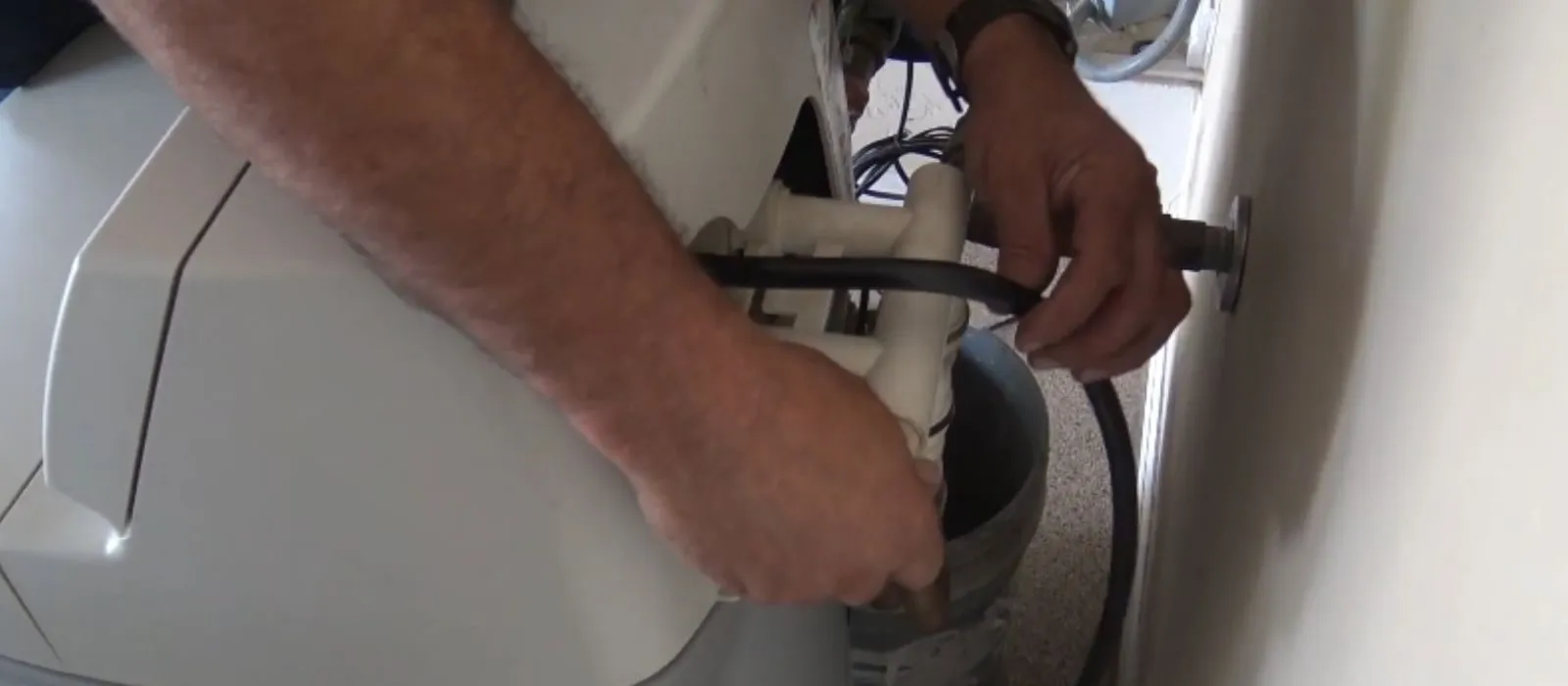
How a water softener installation works from start to finish
A water softener is a tank of resin beads plus a brine tank that holds salt. Hard water flows through the resin, which grabs the hardness minerals and releases sodium or potassium in their place. Every so often the unit regenerates, flushing the captured minerals to a drain.
That description tells you what an installation needs: a connection to the main water line, a drain for the regeneration water, a power outlet for the control head and a spot with room for salt. Everything else is detail.
This guide follows the order of work a plumber uses, so you know what to expect on the day.
The order of work
Most installations take a few hours when the layout is simple.
Choose the spot
The unit goes on the main line after the meter and before the water heater, near a drain and an outlet.
Shut off and drain
The main valve is closed and the lines are drained.
Cut in and connect
A section of pipe is cut out, and the inlet and outlet are connected with a bypass valve set.
Run the drain
A drain hose goes to a standpipe, a floor drain or a laundry tub, with an air gap.
Add resin and salt
The brine tank is filled with salt, and the unit is programmed with the water hardness.
Start up and test
Water is turned on slowly, the system is purged of air, a regeneration is run and every joint is checked.
What the location needs
Check these before you buy.
Space
Room for the tank, the brine tank and access to add salt.
A drain
A standpipe, a floor drain or a laundry tub that can take regeneration water.
Power
A nearby outlet. Keep the transformer plugged in at all times.
A level floor
A solid, flat spot that can carry the weight of wet resin and salt.
A bypass
A valve set that lets you isolate the unit for service.
Temperature
A spot that does not freeze.
Want a softener installed?
Call and a plumber can look at the layout and give you a clear price.
Pipe connections by material
The plumber matches the connection to what is already in your wall.
| Existing pipe | Common connection |
|---|---|
| Copper | Soldered or push-fit fittings with a bypass |
| PEX | Crimp or expansion fittings and a bypass |
| CPVC | Solvent-weld or transition fittings |
| Galvanized steel | A transition to a different material. Old galvanized may need replacing |
The bypass and why you want one
A bypass is a set of valves that lets water skip the softener. You use it when the unit is being serviced, when you need untreated water for a garden or when something goes wrong. A softener without a bypass is hard to maintain, so ask for one.
The plumber also adds a hose bib ahead of the unit, so outside faucets can stay on untreated water. Softened water is not needed to water a lawn.
Setting the controls
At startup, the controller needs your water hardness and the household size. A hardness test at your own tap gives the number. Some units adjust regeneration to actual use, and some run on a set schedule. The right settings save salt and water. See water softener and filtration for the full service.
What happens on installation day
A plumber arrives, confirms the planned location and shuts off the main water. The house will be without water for a few hours while the connections are made, so run the dishwasher and fill a few pitchers beforehand. When the plumbing is done, water comes back on slowly to push air out of the lines.
Expect a first regeneration to be run before the plumber leaves, and a short walkthrough. You will be shown the bypass, the salt fill and the controls. Ask for the manual and the warranty papers.
Mistakes that cause trouble later
Most are avoidable.
No air gap on the drain
Without one, dirty drain water can siphon back into the softener.
Wrong hardness setting
A setting too low leaves hard water, and one too high wastes salt.
Unit after the water heater
Hot water would pass through untreated.
No bypass
Service becomes a plumbing job instead of a quick turn of a valve.
Plugged into a switched outlet
If the power is cut, the controller loses its schedule.
Running costs after the install
A softener has small ongoing costs, mainly salt, water for regeneration and a little electricity. An efficient demand-initiated model uses less of each than a timer-driven one. Ask the plumber how much salt a typical month will use in your house so there are no surprises.
Plan to add salt every month or two and to look at the unit when you do. If you move, the unit can be left, taken along or sold, and the plumber can explain what it takes to disconnect it cleanly.
Grapevine's water numbers for setting the controls
According to Grapevine's 2024 water quality report, hardness is 117 ppm for water produced by the city and 135 ppm for water purchased from the Trinity River Authority, measured as calcium carbonate. Divide ppm by 17.1 to get grains per gallon, which gives about 6.8 and 7.9.
The report also names chloramines as the city's disinfectant. A softener does not remove chloramines. For questions about the report, the city lists 817.410.3330 for water quality. A permit may apply to adding a unit, so ask Grapevine Building Services at (817) 410-3165.
Source type: City of Grapevine 2024 water quality report and City of Grapevine Building Services.
Questions homeowners ask
Where does a softener go in a house?
On the main line after the meter and before the water heater, near a drain and an outlet.
Does a softener need a drain?
Yes. It flushes regeneration water to a drain, usually through a standpipe or a floor drain with an air gap.
What hardness number do I set for Grapevine?
Test your own tap. The 2024 report lists 117 ppm for city water and 135 ppm for TRA water, about 6.8 and 7.9 grains.
Will a softener remove chloramine?
No. A carbon filter is the usual tool for chlorine and chloramine taste.
Do I need a permit?
Possibly. Ask Grapevine Building Services at (817) 410-3165.
A softener install is a simple plumbing job when the layout is right. Plan the drain, the power and the bypass first, and set the controls from a real hardness test.
If you are in a nearby town, see our Southlake plumbing page and the service area page.