
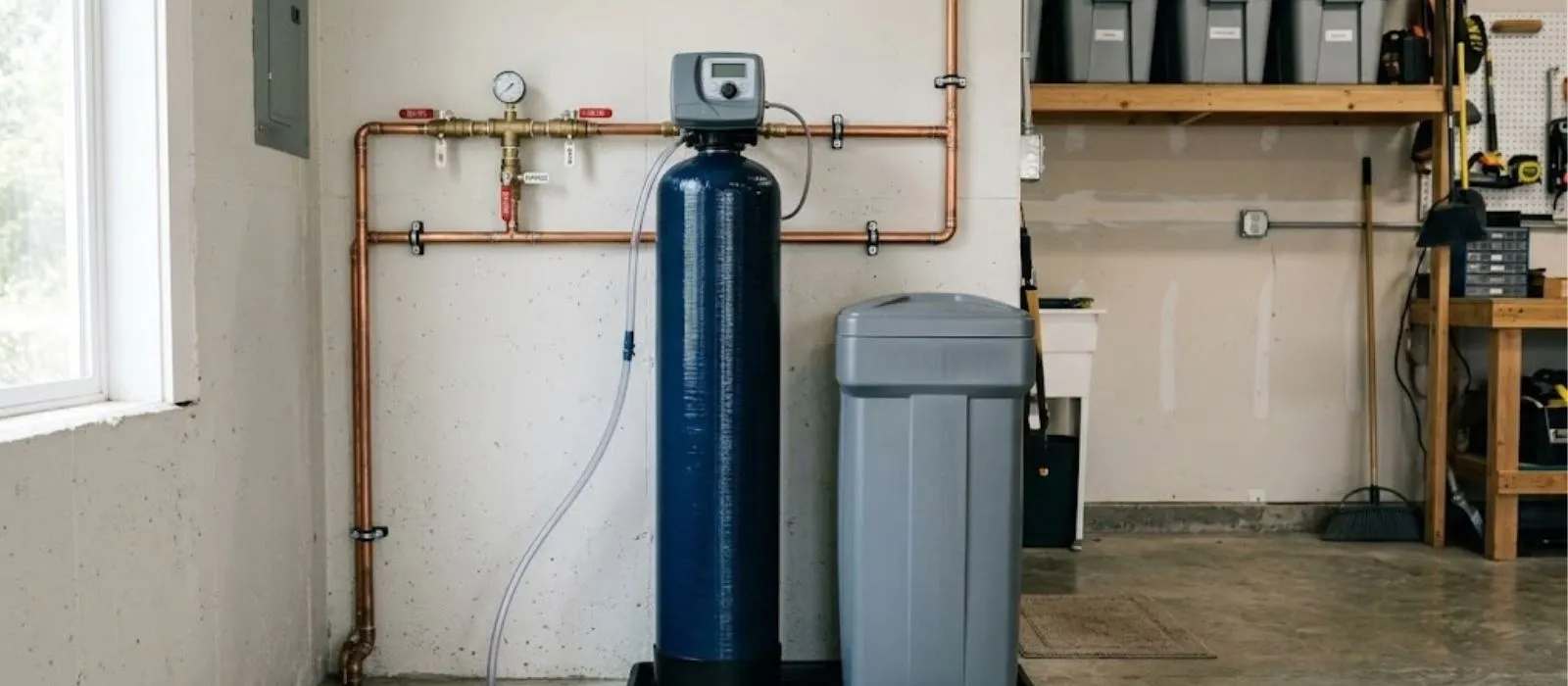
Sizing and choosing a whole house water softener
A whole house softener treats every tap in the house. That is different from a small under-sink filter, and the unit has to be sized for the whole household. Too small and it regenerates too often and wastes salt. Too large and the resin can sit idle.
Sizing comes from two numbers, the hardness of your water and how much water your household uses. Together they give the grains of hardness the unit must remove each day.
This guide shows how those numbers fit together and what other choices matter.
How to size a softener
A plumber does this arithmetic for you, but it helps to know how.
Get the hardness
Test your tap. Convert ppm to grains per gallon by dividing by 17.1.
Estimate daily use
Count household members and typical water use, or read the meter.
Multiply
Gallons used per day times grains per gallon gives grains of hardness removed per day.
Pick the capacity
Choose a unit whose capacity covers several days between regenerations, so it is not recharging constantly.
Choices that shape the unit
Each choice trades cost, salt and water.
| Choice | Options | What to consider |
|---|---|---|
| Regeneration control | Timer or demand-initiated | Demand units regenerate based on use and save salt |
| Salt type | Sodium chloride or potassium chloride | Potassium costs more and some people choose it for sodium reasons |
| Tank layout | Single or twin tank | Twin tanks give continuous soft water |
| Extras | Iron filter, carbon filter | Add only what your water needs |
Want your softener sized correctly?
Call and a plumber can size it to your house.
Where the unit goes
Placement affects performance and service.
After the meter
So all water in the house passes through it.
Before the water heater
To protect the heater from scale.
Near a drain and an outlet
For regeneration and controls.
Out of the sun and frost
Heat and cold shorten the life of resin and parts.
With a bypass
For service and for outside taps.
Salt, sodium and drinking water
A softener adds a small amount of sodium to the water it treats, or potassium if you use that salt. If someone in your home watches sodium, ask a doctor and consider a separate untreated tap for drinking. Many homes install a reverse osmosis unit at the kitchen sink for drinking water.
Keep the brine tank at least a quarter full, and use the salt type the maker recommends. A salt bridge, a crust that stops salt from dissolving, is the common cause of a softener that stops softening.
What the unit does not do
A softener does not remove chloramine or sediment and it does not make water pure. Add a carbon filter for taste, and a sediment filter for particles. See water softener and filtration to learn how a plumber matches the system to your water, and plumbing installation for the work behind it.
A worked example of the sizing math
Here is the arithmetic with made-up numbers, not Grapevine data. A household uses 300 gallons a day, and its water measures 7 grains per gallon. Multiply them and the system must remove about 2,100 grains a day. A unit rated for 30,000 grains would then go roughly two weeks between regenerations at full capacity, though real units reserve a margin.
The point is that a bigger household or harder water shortens that gap. Swap in your own numbers, or let the plumber do it. The math is why two neighbors can buy different units for the same street.
Questions to ask a supplier
The answers separate a good system from a sales pitch.
How much salt and water per regeneration?
Efficient units use less of both.
What is the warranty on the tank, the resin and the control head?
Get all three in writing.
Is the capacity rating at a salt dose I will really use?
Ratings can assume a high salt dose.
Who services it?
A unit with no local service is hard to keep running.
What does the installation include?
Bypass, drain, hose bib and startup should be listed.
Maintaining the system after installation
Check the salt monthly and fill the brine tank before it runs low. Look for a salt bridge by poking the salt with a broom handle. Clean the brine tank once a year and use a resin cleaner if the maker recommends one. Resin lasts many years, but iron or chlorine can shorten that.
If the water starts to feel hard again, check the salt, the bypass position and the settings before you call. A short log of dates and salt fills helps a plumber diagnose a problem quickly.
Grapevine's hardness figures and what they mean for sizing
According to the 2024 water quality report, Grapevine lists hardness of 117 ppm for city water and 135 ppm for Trinity River Authority water, which is about 6.8 and 7.9 grains per gallon. The city's watering page says its supply is roughly 70 percent TRA water and 30 percent from Lake Grapevine, so the mix at your tap can fall in between.
That is why a test at your own tap beats a single number. The report lists a hardness range, and USGS notes that scale shortens equipment life and raises heating costs. Ask the city's water quality contact at 817.410.3330 about your area if you want to know which supply reaches you.
Source type: City of Grapevine 2024 water quality report, City of Grapevine watering page and USGS guidance.
Questions homeowners ask
How big a softener does my Grapevine home need?
It depends on your household's water use and the hardness at your tap. The city lists 117 to 135 ppm, about 6.8 to 7.9 grains per gallon.
Is it better to use sodium or potassium salt?
Both work. Potassium costs more and is chosen by people who limit sodium.
Can I tell which supply reaches my house?
Ask the city's water quality contact at 817.410.3330. A tap test shows your actual hardness.
Will a softener protect my pipes?
It reduces scale that can build up in pipes and fixtures. It does not repair existing corrosion.
How often does a softener regenerate?
It depends on capacity, hardness and use. Demand units adjust automatically.
Size from real numbers, not rules of thumb. Test the water, estimate the use, pick a capacity that does not recharge every day and plan a bypass and a drinking water tap.
For nearby coverage, see our Southlake plumbing page and the service area page.