
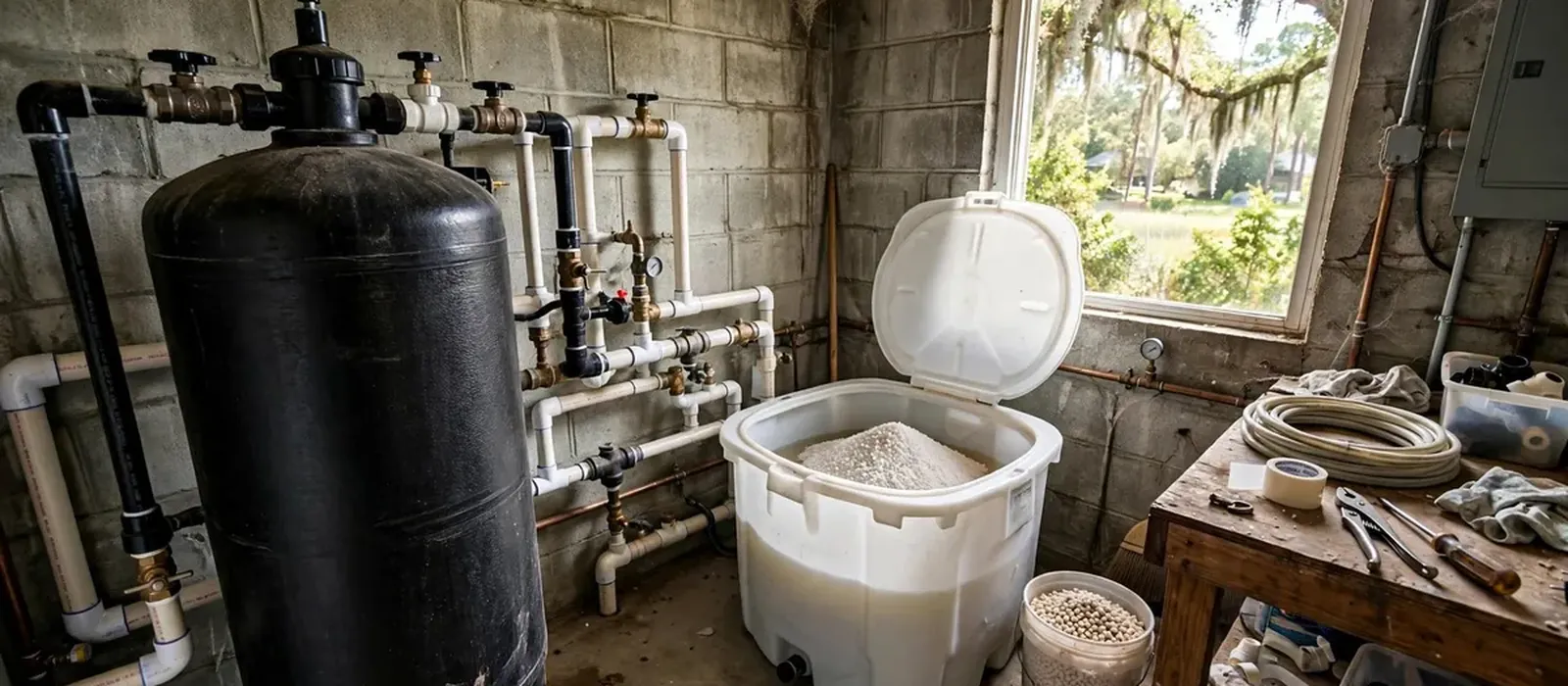
Can you install a water softener outside?
A water softener can be installed outdoors, but it needs protection. The resin tank, the control head, the brine tank and the plumbing are all affected by sun, heat, rain and freezing. An indoor spot is the first choice when there is one.
If your main line enters the house on an outside wall and there is no room inside, an outdoor install may be the practical choice. Done right, it works for years. Done carelessly, it fails in the first hard freeze or the first long summer.
This guide covers the risks and the protections.
The risks of an outdoor spot
Each one has a fix.
Freezing
A frozen tank or pipe can split. Insulate and heat, or choose an enclosure.
Direct sun and heat
Ultraviolet light and heat make plastic brittle and can overheat the resin.
Rain and flooding
Water near the electrical connection is dangerous. Raise the unit and seal connections.
Debris and pests
Leaves, insects and animals can clog the brine tank or the drain.
Theft and tampering
An exposed unit invites trouble. A locked enclosure helps.
How to set up an outdoor install
The goal is a small weatherproof shed for the unit.
Pick a shaded, level pad
A concrete pad keeps the unit level and above splash.
Build or buy an enclosure
A vented, insulated cabinet protects the tank and controls.
Protect the pipes
Insulate every pipe and fitting, and consider heat tape on exposed lines.
Seal the power
Use a weatherproof, GFCI-protected outlet or a protected cover.
Plan the drain
Run the drain to a legal location with an air gap and no freezing risk.
Not sure where a softener should go?
Call and a plumber can look at your main and your options.
Indoor and outdoor compared
The trade-offs are clear.
| Question | Indoor | Outdoor |
|---|---|---|
| Weather exposure | Low | High, needs an enclosure |
| Cost to install | Usually lower | Adds an enclosure and protection |
| Service access | Easy | Depends on the enclosure |
| Risk of freeze damage | Low in a conditioned space | Needs insulation and care |
Power, drain and permits outdoors
Outdoor electrical work has special rules for weatherproofing and ground-fault protection. If the outlet is not already there, an electrician should install it. The drain must also meet code, and a drain run that crosses a yard can freeze or clog.
A plumber can tell you whether a permit applies and who should do the electrical work. A neat install is one you can service easily, so leave room around the unit.
When an indoor spot is better
If you have a garage, a utility room or a closet near the main, use it. If the main enters on a side wall, ask whether the water line can be extended to a protected spot. A longer pipe run costs less than replacing a frozen softener. See water softener and filtration for the full list of options.
A quick freeze-protection plan
Before winter, check that the enclosure door closes, the vents are clear and the insulation is dry. Insulate every exposed pipe, and consider heat tape rated for plastic or copper, as the pipe type requires. Learn where the bypass and main valves are, so you can isolate the unit if a hard freeze is forecast.
If you expect a very long freeze and cannot protect the unit, shut off the water to the softener, open the bypass and drain the tank following the maker's directions. A drained unit cannot freeze and split, and the house still has water through the bypass.
Checklist for a protected outdoor unit
A short list to review each season.
Enclosure
Dry, vented, insulated, latched.
Pad
Level, solid and above splash.
Electrical
Weatherproof, GFCI-protected, lifted above ground.
Drain
Clear, with an air gap and no sag where water can freeze.
Salt
Stored dry, topped up before a long cold spell.
Servicing an outdoor unit
An outdoor softener needs the same care as an indoor one, plus a seasonal look at the enclosure. Check the salt level monthly, wipe away spiders and debris and listen for the unit regenerating. A unit that is hard to reach gets neglected, so leave a clear path to the door and room to lift salt bags.
Keep the manual, the install receipt and the plumber's notes in one folder. When something fails, the model number and the hardness setting are the first things a service plumber asks for.
Alternatives if outdoors is the only option
Some houses have a main line that can be extended to a better spot, such as a garage or a utility closet. Others use a smaller point-of-entry filter, or a treatment system at the kitchen sink. A plumber can price each choice, so you can compare the cost of protecting an outdoor unit against moving the water line.
Texas weather and Grapevine's water system
North Texas can swing from very hot summers to hard freezes. The February 2021 winter storm pushed Grapevine's water use to about 20 million gallons on February 16, compared with about 5 million on a normal day, and the city waived plumbing permit fees afterward. An exposed pipe or tank is the kind of thing a freeze finds.
According to Grapevine's 2024 water quality report, hardness is 117 to 135 ppm, which is moderately hard to hard on the USGS scale, so treatment is worth considering. Ask Grapevine Building Services at (817) 410-3165 whether an outdoor installation needs a permit.
Source type: City of Grapevine storm response reporting, 2024 water quality report, USGS guidance and Grapevine Building Services.
Questions homeowners ask
Can a water softener freeze in Grapevine?
Yes, if it is outside and unprotected. Insulate and enclose it, or choose an indoor spot.
Does an outdoor softener need a permit in Grapevine?
It may. Ask Building Services at (817) 410-3165 about plumbing and electrical rules.
What should I do before a freeze?
Check the enclosure, insulate pipes and consider a heat source. If the unit may freeze, shut it down and drain it.
Is sun a problem for the brine tank?
Yes. Heat and light degrade plastic, so shade the unit.
Is an outdoor softener a good idea in Texas?
It can be, with an insulated, shaded enclosure. An indoor spot is easier to protect.
An outdoor softener is possible, but it is a project with extra parts. Protect it from freeze, sun and water, and keep an indoor spot in mind as the first choice.
For nearby coverage, see our Southlake plumbing page and the service area page.