
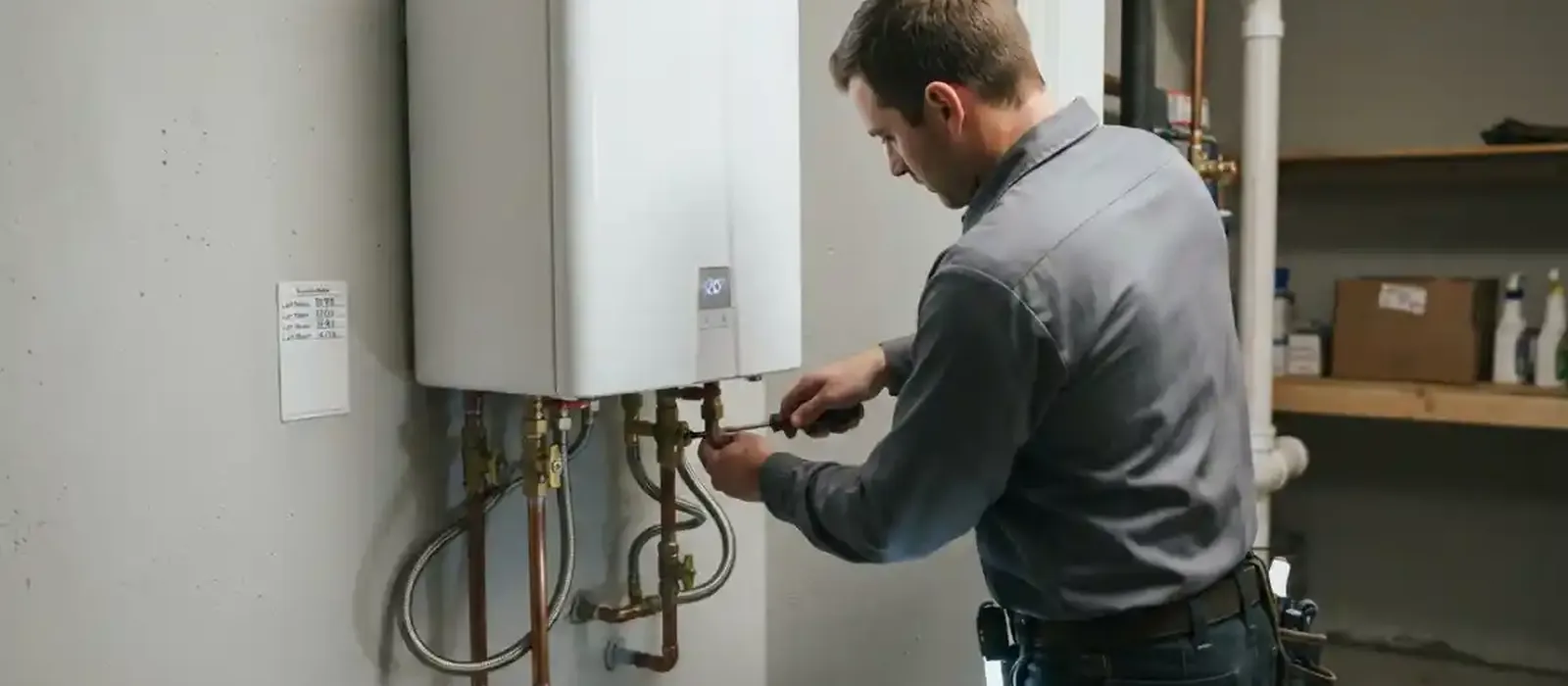
What it takes to replace a tank water heater with a tankless unit
A tankless water heater heats water as it flows instead of storing it. That means no standby tank and a smaller wall-mounted unit, but it also means the unit must deliver a lot of heat at once. The supporting systems, gas, vent, power and water, decide whether a swap works smoothly in a Grapevine home.
Many people ask whether tankless is worth it. The honest answer is that it depends on the house, the number of fixtures running at once and the cost of the changes that come with it. This guide covers those changes so you can ask better questions.
If your tank has just failed and you have no hot water, call first. You can plan the upgrade after the water is back on.
What changes when you go tankless
Each of these is a normal part of the conversion.
Gas supply
Gas units burn a large amount of fuel at once, so the gas line and meter capacity must be checked. An undersized line causes poor performance.
Venting
Most gas tankless units use sealed, special venting that differs from a tank flue. Old vent pipe usually cannot be reused.
Power
Gas units still need an outlet for controls. Electric tankless units need heavy electrical service that many panels cannot supply.
Water connections
Isolation valves for flushing are added, and the old tank piping is reworked.
Condensate
High-efficiency units produce acidic condensate that must drain safely.
Location
Many units mount on a wall, which frees floor space but must meet clearance rules.
Tank and tankless side by side
Neither is better in every house.
| Question | Tank | Tankless |
|---|---|---|
| Hot water supply | Limited by tank size, then recovers | Continuous while within the unit's flow limit |
| Space | Needs floor space | Wall mount |
| Install complexity | Usually simpler | Often more work |
| Maintenance | Drain the tank, check the anode rod | Flush and descale the heat exchanger on a schedule |
| Simultaneous use | Tank buffers demand | Flow limit can matter with several fixtures |
Sizing for the whole house
A tankless heater is rated by how much water it can heat at a given temperature rise. The cold water coming in and the temperature you want decide the flow it can deliver. A household that runs two showers and a dishwasher at the same time needs more capacity than a couple who rarely overlap.
A plumber adds up the fixtures that run together and picks a unit to match. A unit that is too small gives lukewarm water at peak times, which is the most common complaint after a poor tankless install.
Curious whether tankless fits your house?
Call and a plumber can check the gas line, vent and layout and give you a clear price.
How the swap runs
A conversion takes a full visit, not an hour.
Survey
The plumber checks the gas line, vent path, power and clearance.
Remove
The tank is drained, disconnected and hauled out.
Install
The unit is mounted, vented, connected and fitted with flush valves.
Test
Gas connections are leak tested, and the unit is fired and checked at several flow rates.
Maintenance you cannot skip
Tankless units need regular flushing to clear mineral scale from the heat exchanger. Skip it and efficiency drops and error codes follow. Our tankless water heater page covers flushing in more detail.
If scale is a concern in your house, treating the water before the heater helps. See water softener and filtration for the options.
Gas or electric tankless
Gas units deliver more hot water at once and are the common choice for whole-house use, but they need venting and a large gas supply. Electric units need no venting, but a whole-house model draws a lot of power, and many electrical panels cannot support one without an upgrade.
Small electric point-of-use units, which serve a single sink, avoid both problems. A plumber can tell you which type fits your house after checking the panel and the gas meter.
What a tankless flush involves
Flushing keeps the heat exchanger free of scale.
Shut off power and gas
Turn off the unit and close the gas and water valves.
Connect the hoses
Attach hoses to the flush valves, one to a pump and one to a bucket.
Circulate descaler
Run a food-safe descaling solution through the unit for the time the maker specifies.
Rinse and restore
Flush with clean water, reopen the valves and check for leaks and error codes.
Warranty and registration
Manufacturers often require proper venting, flush valves and a record of maintenance to keep a warranty valid. Register the unit, keep the install receipt and ask the plumber to note the flush valves on the invoice.
Grapevine water and permits for a tankless conversion
Grapevine's own 2024 water quality report shows hardness of 117 ppm for city water and 135 ppm for water bought from the Trinity River Authority. On the USGS scale, 117 falls in the moderately hard range and 135 in the hard range. Scale builds on heat exchangers, so a flush schedule matters more with a tankless unit than it may seem.
The city's permit application includes a residential A/C and water heater change out category, and the City lists the 2021 International Plumbing Code (IPC), effective January 1, 2024. Ask Building Services at (817) 410-3165 which permit applies when you change the type of heater.
Source type: City of Grapevine 2024 water quality report, USGS water hardness classes and City of Grapevine permit pages.
Questions homeowners ask
Will a tankless heater save me money in Grapevine?
It can lower standby loss, but the conversion work and the unit cost matter too. Whether it pays off depends on your house and use.
Does Grapevine's water hardness matter for tankless?
Yes. The 2024 report lists 117 and 135 ppm hardness. Scale forms on the heat exchanger, so plan to flush the unit on a schedule.
Can I keep my old vent?
Usually not. Tankless units typically need their own vent type, and the plumber checks what fits.
Is my gas line big enough?
That has to be checked. Tankless units use a lot of gas at once, and an undersized line limits performance.
Do I need a permit to switch to tankless?
Probably. Grapevine's permit application lists a water heater change out category. Ask Building Services.
A tankless swap works best when someone checks the gas, vent and power first and sizes the unit for how you really use hot water. If the survey turns up a problem, you will know before you buy.
If you are in a nearby town, see our Southlake plumbing page and the service area page.