
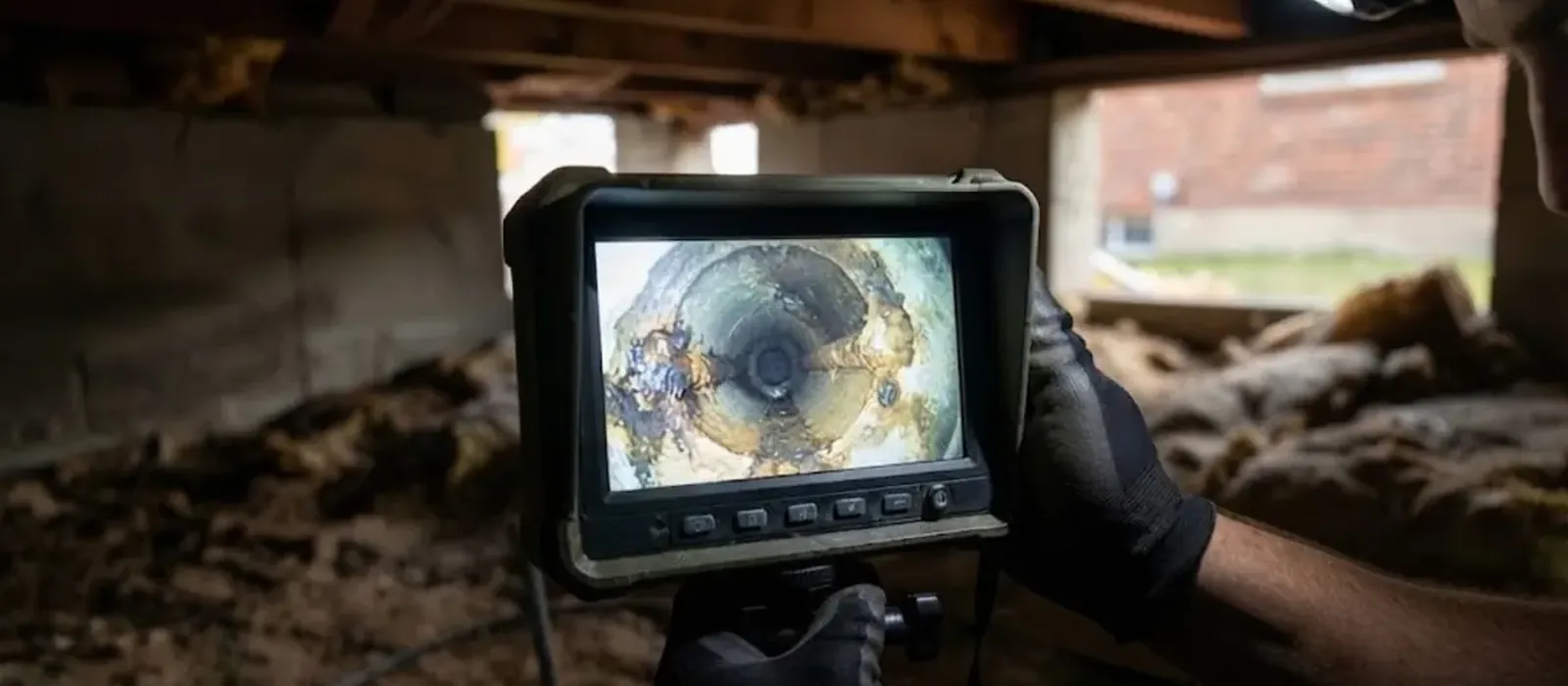
What a sewer camera inspection finds, and why it is worth it
A sewer camera inspection sends a waterproof camera through your drain line and records what it sees. The plumber watches the screen live, marks where problems are and gives you a recording. It turns a guess into a diagnosis.
People book one when drains back up repeatedly, before buying a house or after a clog that keeps coming back. The camera shows whether the cause is roots, grease, a collapsed section or a simple blockage.
Here is what the camera can show, how to read it and what to ask the plumber afterward.
What a camera can find
Each problem looks different on screen.
Tree roots
Fine roots enter at joints and grow into thick masses. They look like hair or webbing.
Grease and buildup
Hardened grease narrows the pipe. It looks like a rough coating.
Belly or sag
A low spot holds water and waste. The camera shows standing water.
Cracks and breaks
A crack looks like a dark line. A break can show soil or a gap.
Offset joints
Pipe sections that have shifted do not line up.
Collapse
The pipe is crushed or blocked by soil and cannot be passed.
How the inspection runs
The visit is usually short.
Find an access point
A cleanout, a toilet removal or a roof vent gives a way in.
Feed the camera
The plumber pushes the camera along the pipe and watches the screen.
Mark and measure
A locator on the camera finds where each problem sits and how deep.
Review and record
You see the video, and the plumber explains the options.
What the findings mean for the next step
The camera tells you which fix fits.
| Finding | Common next step |
|---|---|
| Light grease or debris | Cleaning. See sewer line cleaning |
| Heavy grease buildup | Hydro jetting. See hydro jetting |
| Roots in joints | Cut the roots, then monitor or repair the joint |
| Crack, break or collapse | Repair or replace. See sewer line repair |
| No problem found | Look at the house plumbing or vents |
Repeated backups in the main line?
Call and a plumber can run a camera and show you the cause.
When to book an inspection
Book one when drains back up more than once, when more than one fixture is slow, when you smell sewage near the yard or when you are buying an older house. A camera before you buy tells you what the seller's inspection may not, and the video can support a price negotiation.
Book one after a clog is cleared too, if it was a main line backup. The camera confirms that the cause is gone.
What to ask afterward
Ask for the recording and for the location of every problem. Ask how far along the line each is and how deep. Ask whether the plumber can repair what you saw, and what the price is before work starts. A plumber who explains what they saw and what each choice costs is one you can trust. Also see sewer inspection for what a visit includes.
Limits of a camera inspection
A camera shows the inside of the pipe, but it cannot see through a fully blocked line, and a very tight bend or a transition can stop it. A plumber may clear the pipe first and then inspect, so the camera can pass.
The camera also cannot test whether a joint leaks under pressure. If the picture shows a joint that looks tight but you still see signs of leaking, further testing may be needed. Ask what the camera could not see, and what that means for the next step.
How to get the most from the video
A few habits make the recording more useful.
Ask for footage and a locate
Get the video and a note of where each problem sits and how deep.
Note the pipe material
The camera usually shows whether the pipe is clay, cast iron, plastic or another type.
Save it for later
Keep the file with your house records, because the next buyer or plumber may want it.
Compare quotes
Share the same video with two plumbers so you are comparing the same facts.
Reading the signs before you book
Some warning signs show up well before a line fails. Gurgling in a tub when a toilet is flushed, drains that clear and then slow again, damp or sunken ground over the line and a sewage smell in the yard all deserve a look. Several slow fixtures at once usually mean the main line, not a single drain.
If you own an older house, a camera pass is a sensible habit every few years. It costs little compared with a collapsed line, and the video gives you a baseline to compare against later.
Sewer rates, permits and public lines in Grapevine and Southlake
According to reporting on the city's storm response, the City of Grapevine excluded February 2021 from its winter sewer rates, so sewer charges are something to ask utility billing about after a leak or a high-use month. A camera inspection is separate from the bill, but it can show whether the line itself is the problem.
For public sewer or water problems in Southlake, Public Works has an after-hours line at (817) 748-8082. If a repair on your own line needs a permit, ask Grapevine Building Services at (817) 410-3165 or Southlake Building Inspections at (817) 748-8236.
Source type: City of Grapevine storm response reporting and City of Southlake Public Works and Building Inspections pages.
Questions homeowners ask
Can a camera find a leak in a sewer line?
It can show cracks, breaks and standing water. A leak that is not visible may need other tests.
Will I get a recording of the inspection?
Ask for it. A good plumber provides one and explains what it shows.
Is a camera inspection worth it when buying a house in Grapevine?
It is a smart check on an older line. It shows roots, sags and breaks that a visual inspection cannot.
Does Grapevine bill sewer by water use?
The city excluded February 2021 from its winter sewer rates after the storm. Call the city at (817) 410-3000 and ask how your sewer charge is calculated.
How long does an inspection take?
Often under an hour for a typical house, longer if the line is long or blocked.
A camera inspection replaces guessing with evidence. Watch the video, ask where each problem is and choose a fix with the facts in hand.
For service near you, see our Southlake plumbing page and the service area page.